
Your eyes deserve more than a quick vision screening. At Active Eyes, we take the time to examine your vision and your eye health in one thorough visit.
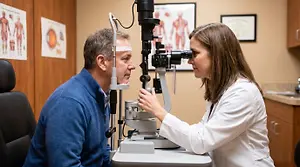
Comprehensive Eye Exams in Littleton
More Than a Prescription
Many people think of an eye exam as the visit where you decide between lens A and lens B and walk out with a prescription for glasses. A full exam at Active Eyes does much more than that.
We also check for early signs of glaucoma, macular degeneration, diabetic eye disease, and other conditions that often have no noticeable symptoms in the early stages. Catching those changes early gives you more options for protecting your sight. Our team can also help you understand your vision plan benefits before care.

Advanced Imaging Technology
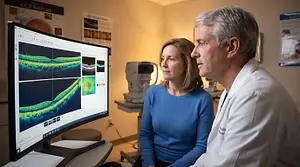
We use imaging to look beneath the surface of your retina and optic nerve, helping us detect problems before they affect your vision. Optical coherence tomography (OCT) and wide-field retinal imaging give us detailed views a standard exam can't. OCT produces a cross-section of your retina and optic nerve to catch early changes from glaucoma or macular degeneration, while wide-field retinal imaging captures a panoramic view in seconds, including areas at the edges that can be easy to miss.
For patients who need contact lens fits or have concerns about corneal shape, we use corneal topography to map the surface of the eye with precision. Together, these tools let us track changes over time rather than waiting until they become a problem.
What We Check in Every Eye Exam
- Visual Acuity: How clearly you see at a distance and up close, and whether your prescription has changed.
- Eye Pressure: Elevated pressure can signal glaucoma, often before any symptoms appear.
- Eye Teaming and Focusing: How well your eyes work together, track, and shift focus, which affects reading and daily tasks.
- Retinal Health: A close look at your retina, macula, and optic nerve for signs of disease or damage.
- Signs of Systemic Disease: Conditions like diabetes, high blood pressure, and autoimmune disorders often show early signs in the eyes.
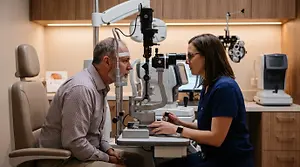
Eye Care for Every Age, From First Exams to Annual Check-Ups
Children benefit from eye exams starting at age one and again before entering school. Many learning and attention difficulties stem from undetected vision problems, so early screening matters. Adults in their 20s and 30s should be seen every one to two years, and more frequently after 40 as the risk of presbyopia and other age-related changes increases. For adults 60 and older, annual exams help catch cataracts, glaucoma, and macular degeneration at a stage when treatment is most effective.
Our team is comfortable with patients at every stage of life. Children with worsening nearsightedness may also benefit from our pediatric eye exams, which include specific testing for myopia and binocular vision.
What to Expect at Active Eyes
- Health History Review: We start by learning about your current vision concerns, family eye history, and general health.
- Visual Acuity Testing: Distance and near vision are tested to determine whether your prescription needs updating.
- Eye Pressure Check: A quick, comfortable test that helps screen for glaucoma risk.
- Slit-Lamp Exam: A magnified look at the front structures of the eye, including the cornea, lens, and eyelids.
- Retinal Imaging: Wide-field photos and OCT imaging of the back of your eye to check for disease.
- Clear Summary of Findings: Before you leave, we walk you through everything we found and answer any questions you have.

Frequently Asked Questions
Most visits take 45 to 60 minutes. If you need dilation, plan for a little extra time for your pupils to return to normal.
Adults with no eye disease: once every one to two years. Children: annually. Patients with diabetes, glaucoma risk, or a strong prescription for glasses: annually or as directed.
Yes. We look for early signs of glaucoma, macular degeneration, diabetic retinopathy, and cataracts during every exam, not just your prescription.
Dilation gives us the clearest view of your retina and optic nerve. We may also use wide-field retinal imaging as an alternative or supplement in some cases.
Dilation blurs near vision and increases light sensitivity for two to four hours. Most patients can drive, but it helps to bring sunglasses.
Book Your Eye Exam in Littleton
At Active Eyes, your Littleton eye doctor team checks your vision and eye health together, serving patients in Littleton and the nearby foothill communities. View our hours and location to plan your next exam.